Paediatric YardCard Set - Paediatric Vital Signs Lanyard Reference Cards for Children's Nursing + Medical Students

Paediatric YardCard Set - Paediatric Vital Signs Lanyard Reference Cards for Children's Nursing + Medical Students

Regular price£9.99
/
Tax included.

Title
  • Free worldwide shipping
  • In stock, ready to ship
  • Inventory on the way


Designed for healthcare professionals and students working with children, this paediatric bundle brings together some of the most useful everyday reference tools for paediatric placements, wards and revision.

The set includes 6 double-sided PVC cards covering:

  • Paediatric Vital Signs & Deterioration
  • WETFLAG & Paediatric Emergency Drug References
  • Developmental Milestones
  • APGAR & SBAR
  • Child-Friendly Stool Chart & Paediatric Constipation
  • Glasgow Coma Scale & Paediatric Pain Faces

Paediatric Vital Signs & Deterioration

One of the first things you notice in paediatrics is that the basics change with age. Babies, infants, children and teenagers all have different normal ranges for observations.

This card includes age-specific reference ranges for:

  • Heart rate
  • Respiratory rate
  • Systolic blood pressure
  • Signs of respiratory distress
  • Maintenance fluid requirements
  • AVPU

A useful quick-reference card for placements, ward work and revision. 

WETFLAG & Paediatric Emergency References

A compact paediatric acute-care card covering the familiar WETFLAG framework alongside commonly encountered emergency drug and treatment references.

Includes:

  • Weight estimation
  • Defibrillation energy
  • Endotracheal tube sizing
  • Fluid bolus calculation
  • Status epilepticus treatment
  • Adrenaline for cardiac arrest
  • Glucose
  • Cardioversion
  • Amiodarone
  • Atropine
  • Calcium gluconate
  • Lorazepam
  • Anaphylaxis adrenaline doses

Adapted from current Resuscitation Council UK material. 

Developmental Milestones

Developmental milestones are notoriously difficult to remember.

This double-sided card covers four key areas of development:

  • Gross motor
  • Fine motor
  • Language
  • Social development

Milestones are shown from 6 weeks to 4 years, with important limit ages highlighted to make common red flags easier to spot. 

APGAR & SBAR

Two familiar clinical tools on one card.

The APGAR side provides a quick overview of:

  • Appearance
  • Pulse
  • Grimace
  • Activity
  • Respiration

The reverse features a structured SBAR prompt to support clear clinical handover and escalation. 

Child-Friendly Stool Chart & Paediatric Constipation

A practical card designed to help make bowel histories easier with children.

The front uses simple, child-friendly comparisons to help identify stool type, while the reverse includes:

  • Constipation red flags
  • Macrogol-based management principles
  • Advice for families
  • QR link to ERIC constipation resources

The stool chart includes seven illustrated stool types with familiar descriptions such as rabbit droppings, corn on the cob, porridge and gravy. 

Glasgow Coma Scale & Paediatric Pain Faces

The GCS side provides a compact reference for:

  • Eye opening
  • Verbal response
  • Motor response

The reverse features a simple 0–10 pain scale designed as a child-friendly communication aid. 

Designed for the lanyard

Each card is:

  • Credit-card sized
  • Double-sided
  • Durable and wipeable
  • Punched for attaching to a lanyard

Use collapsible tabs for more detailed information that will help customers make a purchasing decision.

Ex: Shipping and return policies, size guides, and other common questions.

This site is protected by hCaptcha and the hCaptcha Privacy Policy and Terms of Service apply.

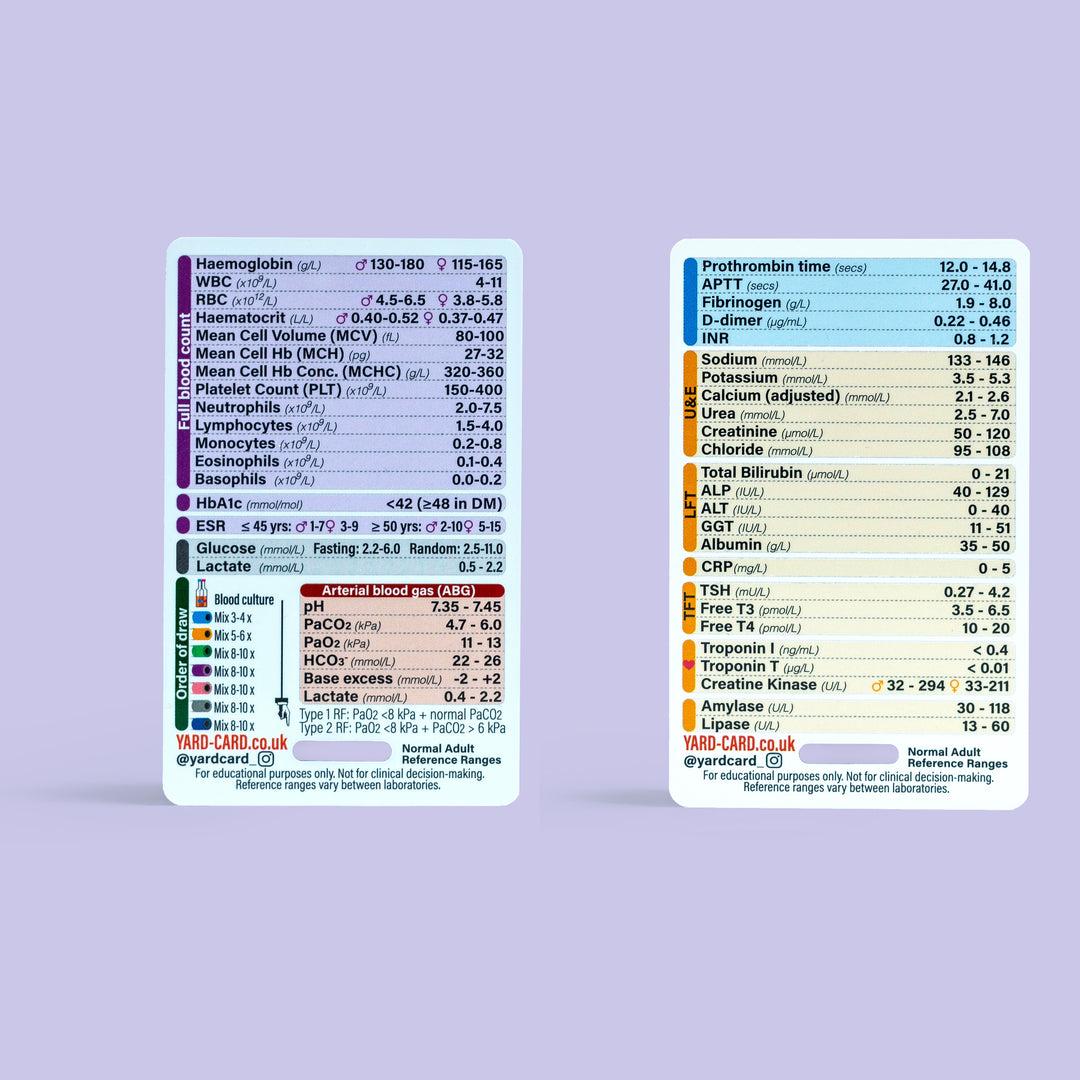
BLOOD RESULT INTERPRETATION MADE EASY

Reference Ranges YardCard

"The patient in Bed 4's Potassium is 6.3, CRP is 155 and WBC is 13"

  • Reference ranges for commonly ordered blood tests including: FBC, U&E, LFT, TFT, HbA1c, Cardiac Biomarkers, Amylase and Lipase, Blood Glucose. Easily learn these values with this card.
  • Arterial Blood Gas interpretation - including criteria for Type 1 and Type 2 Respiratory Failure
  • Order of Draw - collect blood bottles in the correct order
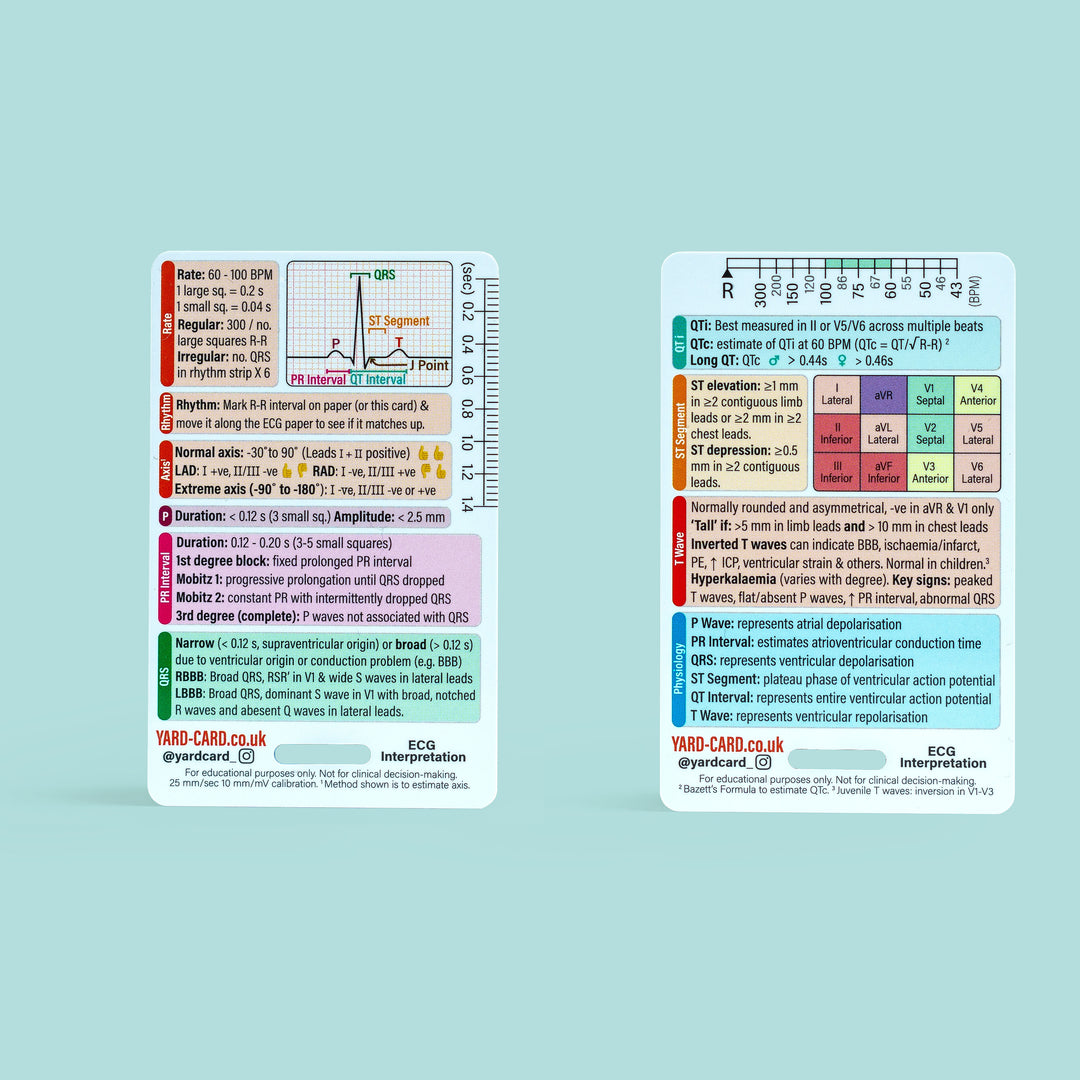
DEMYSTIFY ECGS

ECG Interpretation YardCard

"Can you interpret this ECG?"

  • STEMI criteria and lead diagram - easily remember which leads are Septal, Anterior, Inferior, Lateral, and Inferior
  • Systematic Approach: Rate, Rhythm, Axis, P, QRS, ST, T. For each waveform, the card has the normal ranges in seconds and small squares for ease of interpretation.
  • Understand Pathology: heart blocks, bundle branch blocks, long QT, T wave abnormalities
  • Includes ECG ruler and innovative rate measuring tool: just line the arrow up with the R wave
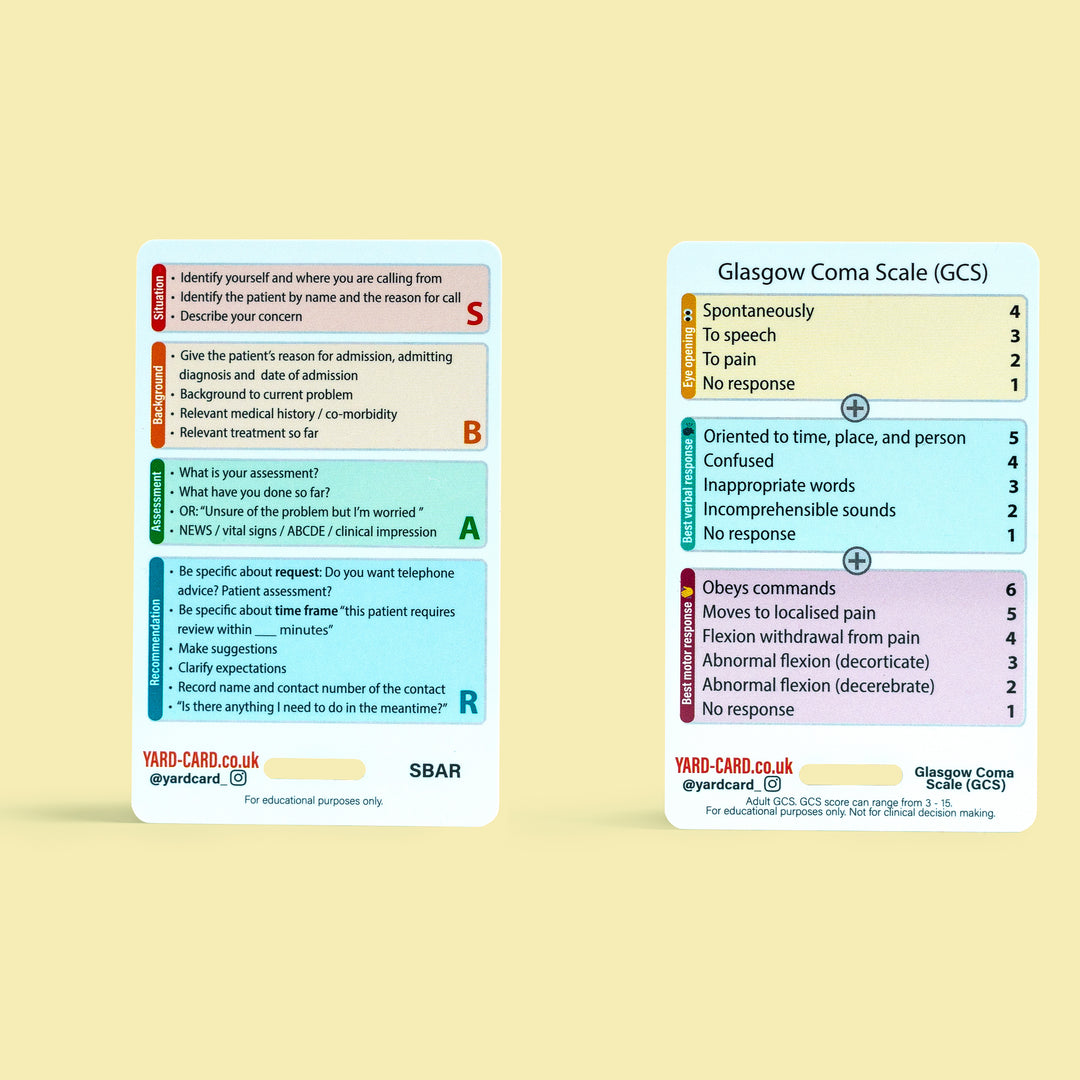
COMMUNICATION IS KEY

GCS/SBAR Handover YardCard

"Is this the on call medical registrar? This is X from Ward X, I'm calling about..."

SBAR (Situation, Background, Assessment, Recommendation) is a structured method for communicating critical information that requires immediate attention and action - a tool for effective handover

"What's the GCS?"

Glasgow Coma Scale (front) is a commonly used scale to assess the conscious level of a patient

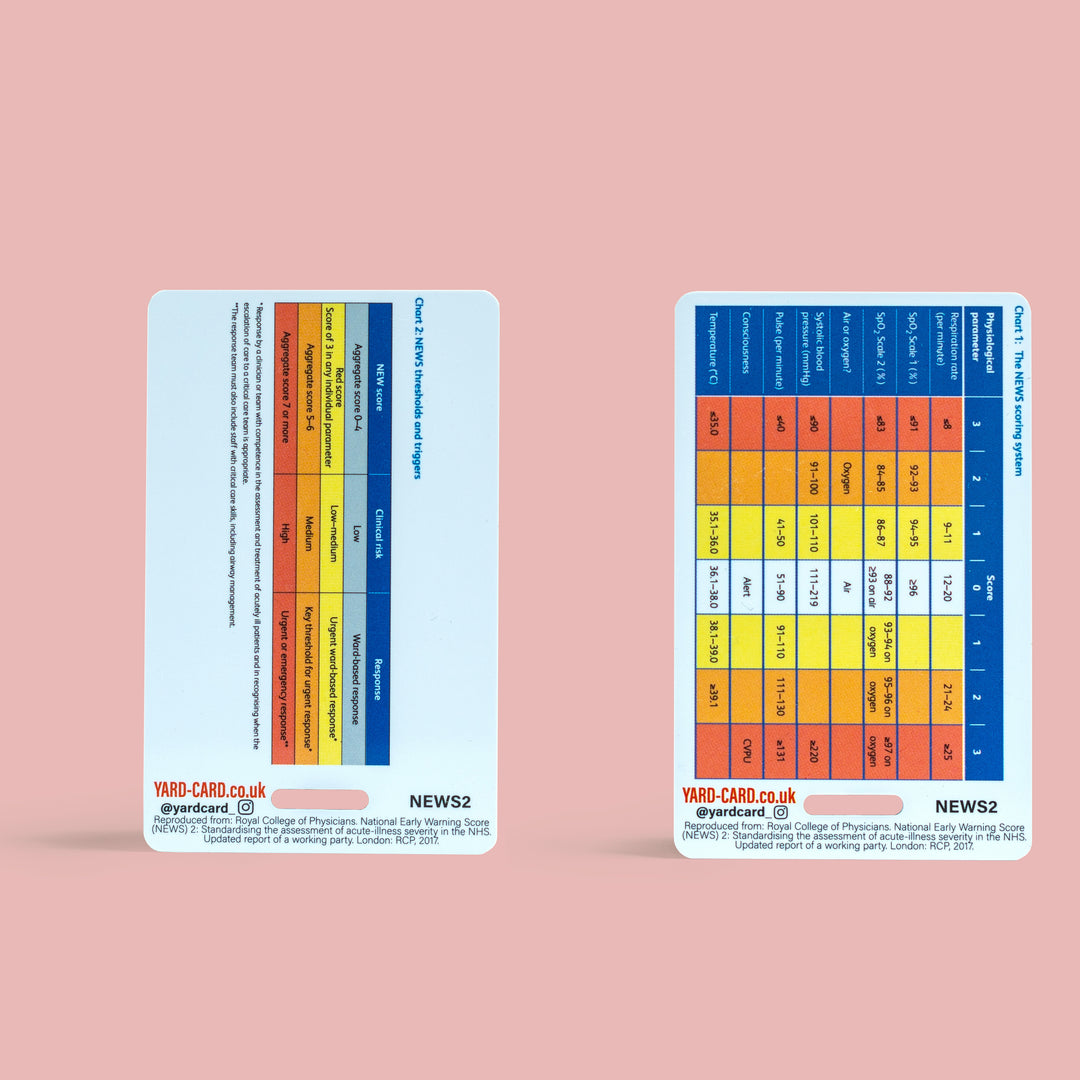
TRACK AND TRIGGER

NEWS2 Yardcard

"The NEWS score is 5 - the blood pressure is 85/40 and the heart rate is 120"

NEWS2 is a system used across the UK for scoring the physiological measurements that are routinely recorded at the patient’s bedside to identify acutely ill patients, including those with sepsis The NEWS2 scoring system measures 6 physiological parameters: respiration rate, oxygen saturation, systolic blood pressure, pulse rate, level of consciousness or new-onset confusion, and temperature

Don't take our word for it

★★★★★

Perfect ideal to have on my ID, I work in a HDU respiratory so the ABG & NEWS2 information is very useful to have on hand! Nice and easy to refer to Ideal for FY1s, student nurses/medical students, NQNs that would benefit from prompts/reminders. They are able to be wipe cleaned so comply with IPC on wards.

Avena

UK

★★★★★

Perfect for their use, I can put them in my pocket or attached them to my work trousers. A fantastic study aid, and they are wipeable which is ideal whilst being on an ambulance. Great quality and came very quickly. Amazing, thank you.

Joanne
★★★★★

Amazing item! Really handy to use in clinical placement, and the cards slot nicely into my ID holder. Will be sending my fellow student nurses your way.

Michelle